
A stronger Canada
Five ways Industrial Mineralization
builds rock-solid foundations
Mount Robson, Canadian Rockies, British Columbia
November 20, 2025
Canada’s strength has always come from the ground up – from its resources, industries, courage and ingenuity. Today, as global dynamics shift, Canada is responding decisively to establish the foundations for a stronger, more self-reliant and sustainable economy – one that reimagines the industries that have long powered its prosperity.
Achieving this vision means strengthening economic sovereignty and technological leadership by integrating innovation across Canada’s resource, industrial and environmental systems – making the transition a driver of global competitiveness.
Industrial Mineralization (IMin) is an emerging cornerstone of Canada’s clean-growth transformation
IMin aligns directly with two of the country’s flagship federal strategies: the Critical Minerals Strategy, focused on protecting natural resources and leveraging them to deliver the clean energy transition, and the Carbon Management Strategy, which advances a clean, inclusive and globally competitive economy that creates quality jobs for Canadians.
IMin also has resounding public support. More than 80% of all Canadians, across ALL provinces, believe carbon removal is essential for Canada’s long term success.
(Source: Carbon Removal Canada / Carbon Business Council, 2025.)
section 2 name
Industrial Mineralization: The Basics
Industrial Mineralization (IMin) refers to a class of carbon removal approaches that leverage alkaline industrial waste streams – from mine tailings to steel slags – to capture and store CO₂ as stable carbonate minerals.
It’s a process that happens naturally in rock over geological time; IMin simply harnesses and accelerates it, using the infrastructure, materials and expertise Canada already has in abundance.
Industrial Mineralization:
1. Creates new revenue through the sale of carbon credits
2. Improves project economics through co-benefits such as improved metals liberation or waste stabilization
3. Repurposes waste and encourages a circular economy
4. Can support low-carbon, responsibly produced minerals and materials
Uniquely suited to Canada’s geology, industry and innovation ecosystem, IMin can be a home grown part of the puzzle to deliver the national clean-growth ambitions.
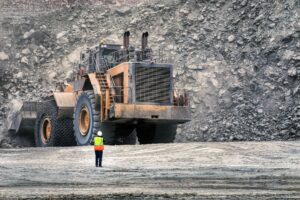
Working within Canada’s existing industrial footprint
1. IMin strengthens Canada’s economic resilience
“In this time of uncertainty, there is also a heightened urgency to make our economy more resilient and competitive”
– Build Canada Strong – Budget 2025
Canada’s Carbon Management Strategy calls for technologies that can scale rapidly, strengthen economic resilience and deliver measurable climate impact.
A more resilient economy will emerge from diversifying the economy into new industries. IMin meets this brief.
According to McKinsey, by 2050, carbon dioxide removal (CDR) will be an industry valued at least USD$1 trillion dollars per year. The emergence and growth of this industry is an economic opportunity for Canada.
By working within Canada’s existing industrial footprint, from mines to steel and cement operations, IMin has the potential to scale rapidly. There is no need for new land, pipelines or major infrastructure.
By scaling innovation inside the systems Canada already operates, IMin helps build a home-grown carbon management sector capable of delivering both climate and economic returns.
A home-grown carbon management sector will never leave Canadian taxpayers with stranded assets, or force officials to navigate complicated legacy interests. This is a greenfield opportunity that will create jobs, prosperity and economic security.
2. IMin leverages Canada’s natural and industrial strengths
Canada’s Critical Minerals Strategy highlights the country’s unique advantages: abundant mineral resources, a strong industrial base and world-class geoscience expertise. That expertise is powered, for example, by the University of British Columbia as well as companies like Arca who have already deployed their technology on operating mine sites.
Today, Canada is the only Western nation with significant sources of critical minerals cobalt, graphite, lithium and nickel, already ranking 5th in the world for nickel production. Many critical minerals, including cobalt and nickel, are hosted in mafic and ultramafic rocks, which have the right chemistry for IMin. Rich in magnesium and calcium, these rocks naturally react with CO₂ to form stable carbonate minerals. The same geology that gives Canada its critical minerals also provides the chemistry for carbon mineralization.
Demand for critical minerals is expected to increase up to sixfold by 2040 to support the global clean-energy transition – and by more than twentyfold for some commodities. IMin can improve project economics by creating new revenue through the sale of high-integrity carbon credits and through valuable co-benefits such as improved metals liberation and waste stabilization. IMin supports a circular model for resource development by repurposing waste into value. This can differentiate Canadian exports as low-carbon, responsibly produced materials.
IMin therefore has the potential to help strengthen industrial resilience and ensures that Canada’s natural resource wealth continues to serve national prosperity for generations to come.
Source: Canadian Critical Minerals Strategy (2022).

Building a cleaner, stronger and more durable future for Canada. Photo by Tom Carnegie on Unsplash.
3. IMin contributes to a prosperous and resilient net-zero economy for all Canadians
Canada’s path to net zero depends on solutions that are circular, inclusive and capable of creating lasting economic opportunity.
IMin embodies this principle by using two wrongs to make a right. It repurposes two waste streams – the excess CO₂ in the atmosphere and alkaline industrial waste – into one climate solution, while generating new revenue and jobs.
According to the 2023 Carbon Removal Canada report, durable CDR is set to deliver 300,000 Canadian jobs and CAN $143 billion GDP. By leveraging Canada’s natural, industrial and scientific strengths, IMin can play a role in securing this and help Canada to build a cleaner, stronger and more durable future.

A First Nations totem pole in BC, Canada
4. IMin helps advance reconciliation
Federal strategies place Indigenous leadership and economic reconciliation at the heart of Canada’s clean-growth agenda.
Many IMin opportunities are located on or near Indigenous territories. Done right, this opens the possibility for new models of equitable partnership between IMin project proponents and host communities. Not only can this involve equity participation and community benefits, but the revenue generated by IMin can in turn be used to restore the land.
By linking climate progress with community prosperity, IMin can contribute to a more inclusive, just and resilient transition for all Canadians – one that aligns economic opportunity with environmental restoration. This is an example of unique Canadian knowledge that can be exported as part of our new emerging national soft power.
5. IMin generates new commodities for global trade
As global demand for durable CDR accelerates, advancing IMin creates a clear export opportunity for Canada.
According to Canada’s Carbon Management Strategy (2024), the global carbon-management sector already represents a multibillion-dollar market, and the International Energy Agency (IEA) projects US $160 billion in cumulative investment by 2030.
IMin reinforces Canada’s leadership in the green transition and strengthens its reputation as an investment destination. Technology providers, project developers and investors are already seeing Canada as a leading jurisdiction for carbon management.
Canada has the capacity to generate more high-integrity carbon removal capacity than domestic demand requires, positioning the country to meet rising international demand. This is already happening, as shown by Microsoft’s recent offtake agreement with Arca for almost 300,000 tonnes of durable CO₂ removal.
Industrial Mineralization supports the federal goal of a globally competitive, innovation-driven economy – one that can supply high-integrity carbon removal at scale while creating value, trust and jobs at home.
Learn more about Arca and Industrial Mineralization, our carbon removal pathway.